


Page 58 - GIS for Science, Volume 3 Preview
P. 58
COLLECTING SPECIES DATA
With more than 1,200 terrestrial vertebrate species (including 22 that are uniquely endemic), Mozambique is historically rich in biodiversity. But from 1977 to 1992, a civil war ravaged the country, destroying critical infrastructure, killing more than a million people through fighting and starvation, and taking a toll on species populations as well. Inside Gorongosa National Park—the jewel of Mozambique’s incredible landscape—populations of large animals decreased by 90% as people turned to hunting bushmeat to survive. Fortunately, Mozambique’s wild places remained relatively intact.
After the war ended, the Gorongosa Restoration Project began its efforts to restore the park’s biodiversity, led by a team of local conservationists and philanthropist Greg Carr. The E.O. Wilson Biodiversity Laboratory at Gorongosa National Park was established to train a new cadre of Mozambican biologists and conservationists to support restoration efforts and to carry out comprehensive surveys of biological diversity in the park. The laboratory is directed by Dr. Piotr Naskrecki, entomologist, conservation biologist, author, photographer, and Half-Earth Chair, based at the Museum of Comparative Zoology at Harvard University.
Gorongosa National Park in Mozambique is one of Africa’s most ambitious wildlife restoration stories.
     Dung beetle species
Sisyphus nanniscus — Pachylomera femoralis — Onthophagus sugillatus — Onthophagus pugionatus — Onthophagus lamelligar — Onthophagus lacustris — Onthophagus bituber — Onthophagus bicavifrons — Onthophagus af. ruginosus — Onitis cf. fulgidus — Kheper subaeneus — Garreta nitens — Diastellopalpus cf. laevibasis — Chalconotus convexus — Carbonarius complex —
 In the Gorges
Plateau
 46
GIS for Science
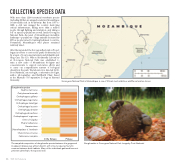
The sampled composition of dung beetle species between the gorge and Dung beetles in Gorongosa National Park. Image by Piotr Naskrecki. its adjacent plateau was almost disjoint, with only one species found in
common between both habitats. Many of the individuals gathered have not
yet been identified to the species level.


