


Page 57 - GIS for Science, Volume 3 Preview
P. 57
THE HALF-EARTH PROJECT
Inspired by E.O. Wilson’s sweeping
call to action in his book Half-Earth:
Our Planet’s Fight for Life, the E.O.
Wilson Biodiversity Foundation
launched the Half-Earth Project© in
2016. Together with its partners, the
Half-Earth Project is driving research
to better understand the species of
our planet and how they interact
with their ecosystems. The project
provides conservation management
leadership by mapping biodiversity,
identifying the best opportunities to protect the most species and engaging with people globally to care for our planet, with the goal of protecting Earth’s biodiversity.
A pillar of the Half-Earth Project is the Half-Earth Project Map, a tool for scientific communication and planning that is collaboratively designed and maintained by four core organizations. Map of Life—the flagship project of Yale University’s Center for Biodiversity and Global Change—leads the scientific research, contributing the information needed for informed conservation planning. Vizzuality—a company of scientists, developers, and data visualization specialists—leads the user-centered design and development aspects, along with Esri, which provides additional cartographic basemap design, spatial analysis, and data management funtionality. And finally, the E.O. Wilson Biodiversity Foundation provides the leadership and vision for the map and other programs such as educational initiatives and the annual Half-Earth Day, bringing the focus and voice of E.O. Wilson to this endeavor.
“The foundation for a new way of understanding the beautiful intricacy of our planet and how we can best steward its enduring stability is science,” says Dr. Paula Ehrlich, president and CEO of the E.O. Wilson Biodiversity Foundation. “When E.O. Wilson conceived of Half-Earth, he imagined that we would bring together our scholarship in many walks of life, many areas of expertise and experience, and work together within the spirit of a moonshot. He imagined that by driving significant scientific
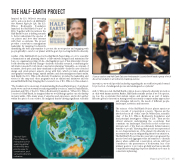
Science teacher and Half-Earth Educator Ambassador Lucretia Smith leads a group of mid- dle-school students in a biodiversity mapping exercise.
innovation, we would provide leadership regarding the most effective path forward for protection of endangered species and endangered ecosystems.”
As E. O. Wilson noted, the Half-Earth solution does not place biodiversity protection at odds with human activity. Rather, Half-Earth reminds us that if we lose species, we lose the ecosystems that sustain nature and sustain us as part of nature. Effective global conservation strategies will necessarily comprise many approaches
and strategies tailored to the needs of different people, landscapes, activities, and interests.
The science of the Half-Earth Project places species as the core unit of conservation concern. “Species are the absolute key in all of this,” says Dr. Walter Jetz, scientific chair of the E.O. Wilson Biodiversity Foundation and lead principal investigator of Map of Life. “They are the critical elements underpinning the ecosystems that constitute our landscapes. They’re the nodes on this very intricate web of life that are ultimately behind nature’s benefits to people.” Ensuring that species are represented in our characterizations of the planet’s biodiversity is a necessary first step in safeguarding them from extinction. The Half-Earth Project tracks conservation progress at the species level and aggregates this information to identify places where additional conservation actions will best contribute to the preservation of biodiversity. One of its primary goals is to provide a globally and taxonomically comprehensive mapping of species distributions for use in conservation planning.
Mapping Half-Earth 45
    The Half-Earth Project Map, an interactive tool for exploring global biodiversity data, priority areas for conservation, and various biodiversity indicators.


