


Page 21 - GIS for Science, Volume 3 Preview
P. 21
long been understood and even mapped at very coarse scales,10 the first higher- resolution global characterization and map of these two fundamental shoreline types was only recently produced.14 Neilson and Costello15 classified lengths of coastline on the mainland and islands of Ireland into cliff, rocky, stony, sandy, and muddy habitats as part of an ecological survey to design a national network of marine protected areas. Those erosional and depositional habitats were found to be primary determinants of species and ecological community occurrences.16 Delving deeper into the classification of depositional environments, three hydrodynamic influences are of primary importance, as described in the classic
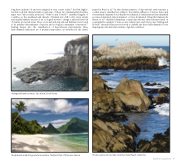
Hexagonal basalt columns, Jeju Island, South Korea.
paper by Boyd et al.17 In this characterization of depositional environments, a coastal area is classified according to the relative influence of waves, tides, and rivers as hydrodynamic forces that move sediment. Coastal areas are then identified as wave-dominated, tide-dominated, or river-dominated. Using this framework, Harris et al.18 classified Australian coastal depositional environments based on a quantitative analysis of wave power, tidal power, and river power. Nyberg and Howell14 extended this previous work to classify the three hydrodynamic forces shaping depositional environments of global coastlines.
   Sandy beaches abutting coastal mountains, National Park of American Samoa.
Rocky coasts and outcrops, Asilomar State Beach, California.
Earth’s Coastlines 9


