


Page 160 - GIS for Science, Volume 3 Preview
P. 160
WHY ACOUSTICS MATTER
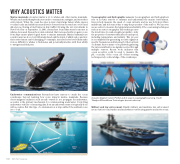
Marine mammals: Acoustics matter a lot to whales and other marine mammals. Whales, such as this humpback, use sound to communicate, navigate, and sense their environment. When the ocean becomes noisier, many large baleen whale species vocalize louder and exhibit increased levels of stress hormones such as cortisol and aldosterone. During a brief hiatus in ship traffic following the terrorist attacks in New York City on September 11, 2001, researchers found that stress hormones in whales decreased. Researchers demonstrated that increased anthropogenic noise from ships causes physiological stress to marine mammals. Marine mammals use sound in ways we do not yet fully understand, and the input of additional sound into their environment can be damaging. For example, increased noise levels likely make it more difficult for whales to find mates and potentially interfere with their ability to navigate and find prey.
Bowhead whale in the Arctic
Underwater communications: Researchers have reasons to study the ocean soundscape beyond learning how noise impacts marine mammals. Because electromagnetic radiation such as radio waves do not propagate far underwater, acoustics is the primary mechanism for communicating underwater. Controlling underwater vehicles or extracting data from an underwater sensor is typically done with acoustics. But this type of communication is impossible if the ambient noise is too loud.
Oceanographic and hydrographic sensors: Oceanographers and hydrographers rely on acoustic sensors to measure and understand the marine environment. Sensors help measure the speed of ocean currents, and we use bottom profilers, multibeam, and side scan sonar to map the properties of the seafloor. We can even use acoustics to measure the temperature and salinity of the ocean using techniques such as acoustic tomography. This technique uses
the travel time of sound along known paths to infer the properties of seawater that affect sound speed, including temperature and salinity. This process is accomplished by generating acoustic signals at specific frequencies and listening for their arrivals on distant sensor arrays or by passively gathering the various ambient noise signals received through multiple sensors. Recent work indicates that ocean acoustics could be used to measure the pH, or acidity, of the ocean. All of these sensing techniques rely on knowledge of the soundscape.
Acoustic Doppler Current Profiler and its uses in oceanographic sensing. Credit: Teledyne RD and Rowe Technologies (acoustic devcice).
Military and law enforcement: Finally, military and maritime law enforcement use acoustics to find surface and underwater vessels using passive and active sonar.
         Surface relection
Sound source
Vessel-to-vessel communiucation.
Noise source
 Hydrophone
Ambient noise
            Bottom relection
 148
GIS for Science
Direct path


