


Page 157 - GIS for Science, Volume 3 Preview
P. 157
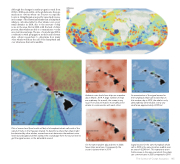
 Although the changes in anthropogenic sound from 2019 to 2020 seem subtle on the global scale, they are much more obvious when one focuses on a specific location. Using Hawaii as a specific case study, we see in the maps of the Hawaiian Islands that a humpback whale is only detectable by other whales over a very small distance in 2019, due to the amount of ship noise in the area. But in 2020, with the lack of ships present, that whales are able to communicate over an area ten times as large. The use of soundscape GIS in combination with propagation models and relevant data allows researchers to determine how many other whales will hear the call of the humpback and over what area that call is audible.
   Plot of source level (how loud it will be) of a humpback whale call north of the island of Oahu in the Hawaiian Islands. To determine where that whale might be detected by other whales, researchers must determine the ambient noise levels (soundscape) and then subtract the soundscape from the source level to get the signal excess, or the detectable sound.
Ambient noise levels from ships on a random day in March 2019. A large number of ships are underway. As a result, the ocean is very loud. The noise will make it more difficult for whales to communicate with each other.
An examination of the signal excess for the humpback whale call reveals that on this random day in 2019, the whale is only detectable by other whales over a very small area, approximately 4,025 km2.
Signal excess for the same humpback whale call in 2020 in the same location audible over an area of 42,240 km2. This represents a ten- fold increase in the area over which this whale can communicate in 2020 compared to 2019.
  On the same random day and time in 2020, fewer ships are at sea. Consequently the ocean is quieter than in 2019.
The Science of Ocean Acoustics 145


