


Page 156 - GIS for Science, Volume 3 Preview
P. 156
THE YEAR OF A QUIETER OCEAN
The COVID-19 pandemic, while tragic on so many levels, has provided scientists with a unique opportunity to study the global soundscape.
The increasing sound levels in our oceans in modern times are generally understood to be detrimental to certain sea life—in particular such creatures as whales, which communicate over long distance using sound. Baleen whales are the largest animals on earth and include gray, humpback, minke, right, blue, and fin whales. All but the gray and humpback whales are considered threatened. These whales emit extremely low-frequency vocalizations that travel surprisingly long distances underwater. The wavelengths of these calls can be longer than the bodies of the whales themselves.
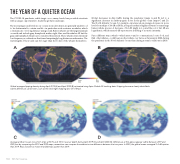
Global decreases in ship traffic during the pandemic (maps A and B) led to a significant decrease in anthropogenic noise in the global ocean (maps C and D). The North Atlantic Ocean, for example, experienced an average decrease in noise levels from ships of 3.4 dB at 50 Hz, a frequency that is highly relevant for many large baleen whale species. A decrease of 3.4 dB might not sound like a lot, but dB are logarithmic, which means 3 dB represents a doubling of acoustic intensity.
Put a different way, a whale—which uses sound to communicate, locate food, and find other whales—could hear another whale over twice as far away in 2020 during the pandemic in the North Atlantic Ocean than during normal conditions in 2019.
AB
Global average shipping density during April 2019 (A) and April 2020 (B) estimated using Spire Global AIS tracking data. Shipping lanes are clearly identifiable. Subtle differences can be seen, such as the less bright shipping lane off of Brazil.
   Fewer Ships
More Ships
    144
GIS for Science
CD
Average ambient ocean noise from ships at 50 Hz and 100 m receiver depth during April 2019 (C) and April 2020 (D). Differences at first glance appear subtle between 2019 and 2020, but by comparing the 2019 and 2020 maps, researchers can compare the ambient noise difference between the two years. In 2020, the global ocean averaged 2–4 dB quieter than 2019. Red, or positive, means that 2020 was quieter than 2019.


