


Page 152 - GIS for Science, Volume 3 Preview
P. 152
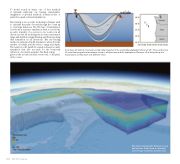
 To model sound in water, one of four methods is typically employed: ray tracing, wavenumber integration or spectral methods, normal modes, or parabolic equation-based simulations.
Ray tracing is an acoustic modeling technique used to calculate the path of sound through the ocean up to very large distances. The 3D map of transmission loss shows a ray trace simulation used to model the acoustic intensity of a source in one location in all directions, first by modeling the acoustic intensity in range and depth at a single bearing, and then repeating that simulation in all directions. This ray tracing method is called an N x 2D simulation, where N is the number of radials, and 2D refers to range and depth. The result is a 3D parabolic equation-based acoustic simulation that also accounts for the horizontal refraction of sound in seawater. The final output
gives us the acoustic field at every voxel, or 3D pixel, in the ocean.
S
R
A ray trace simulation of acoustic energy refracting due to the sound-speed gradient shown at left. The sound source (S) is the boat propeller that releases sound in all directions and the hydrophone (Receiver -R) at left picks up the sound waves as they reach it at different times.
 140
GIS for Science
Ray trace showing paths between source and receiver. Shown here: a horizontal slice through volumetric acoustic field.


