


Page 150 - GIS for Science, Volume 3 Preview
P. 150
OCEAN SOUNDSCAPE
The Monterey Bay Aquarium Research Institute (MBARI) defines the ocean soundscape as “a continuously changing mosaic of sounds that originate from living organisms (communication and foraging), natural processes (breaking waves, wind, rain, earthquakes, etc.), and human activities (shipping, construction, resource extraction, etc.).” The ocean soundscape is 4D, varying in x, y, z, and t.
The soundscape is important because sound is one of the primary ways that we interact with and sense the ocean, which means the soundscape has implications for oceanographers who use acoustic sensors to measure the ocean, marine mammals who use sound to communicate, and the military who uses sound to find vessels such as submarines. The soundscape is a challenge to model, measure, represent, and understand because it is fundamentally 4D. The ocean is volumetric, and the soundscape along with the ocean properties it depends on (such as temperature and salinity) have values in every voxel (3D grid cell), and those values change over time. This 4D workflow can be difficult to manage throughout the process, from gathering and curating the datasets, managing high-bandwidth computational modeling mathematics that are applied to those datasets, making those results available to derivative tools and processes to conduct analysis, and representing and communicating the results of this analysis. That is where effective GIS is paramount.
In this chapter, we discuss the GIS workflow used to model global ambient ocean noise (the soundscape) derived from ship movement and weather phenomena such as wind and waves. This chapter presents changes in the global soundscape that occurred during the coronavirus disease 2019 (COVID-19)
pandemic. Our work focuses on the Arctic as a critical example of this soundscape analysis
and uses the impact of anthropogenic
sound—such as shipping noise
on bowhead whales—as an example of the impact
of this type of analysis.
The ocean soundscape is composed of all the sources of noise that contribute sound to the environment. They include sounds made by humans (anthropogenic; orange sound waves), the environment (natural sounds; green sound waves), and biological sources (animals: marine mammals, fish, and invertebrates; blue sound waves).
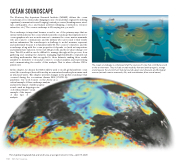
  Plot of global integrated ship and wind noise at a single moment in time—April 15, 2020.
138 GIS for Science


