


Page 186 - GIS for Science, Volume 3 Preview
P. 186
TEACHING PRACTICAL DEEP-LEARNING SKILLS
On September 30, 2012, AlexNet, a neural network model designed and trained by Alex Krizhevsky, achieved a top-5 error of 15.3% in the ImageNet 2012 Challenge— an annual competition that has been instrumental in advancing computer vision and deep-learning research. This achievement came in more than 10.8 percentage points lower than that of the runner-up and launched a new era of convolutional neural networks in image processing. Relying on GPU parallel computations, convolutional neural networks since then have improved state-of-the-art results across the entire spectrum of computer vision and achieved superhuman levels of accuracy in image classification, object detection, segmentation, etc.
The community of deep-learning researchers and the number of practical applications and profitable businesses relying on deep neural networks are growing rapidly, reaching today far beyond the computer vision domain and making groundbreaking leaps in natural language processing, content generation, robotics, time-series analysis, computational physics and biology, partial differential equations, and beauty industry, to name a few. Not surprisingly, geospatial data— the original “big data”—is now coming into focus in the AI world.
The GIS world is not falling behind. Just a few years after the AlexNet introduction, deep neural networks have transformed and keep delivering new spatial analytic capabilities at an accelerating pace. For example, the ArcGIS API for Python’s Learn module effectively tripled in size during 2020, bringing the count to about 30 ready- to-use deep neural networks in its November release.
Deep learning as a field has its own detailed and specific workflows covering data preparation, training and validation of neural networks, and deployment of trained models. The ArcGIS Platform seamlessly integrates these tasks into traditional GIS workflows through a set of tailored geoprocessing tools (APIs) that offer enhanced and distributed functionality. The result has been a more streamlined integration of deep-learning capabilities into research and production systems, and growing interest from the academic community.
Deep learning can be thought of as an evolution of machine learning. Where traditional machine learning requires explicit and careful preparation of input features (training examples) by the programmers and data scientists, deep learning relies on large graph structures and corresponding algorithms making them less sensitive to noise and correlations in the input data.
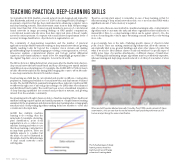
ArcGIS has multiple machine learning tools covering often the same tasks, for example, clustering, pixel classification, point cloud segmentation, etc., so when to use machine learning and when to use their deep-learning counterparts is an important question. There are multiple aspects to consider, but the main one can be illustrated in this simple chart: the full advantage of deep neural networks comes with big data.
Therefore, an important aspect to remember in case of deep learning, is that for efficient training of deep neural network models, one or more modern GPUs with a significant amount of video memory is required.
And, of course, there are cases in which no machine learning models, or deterministic algorithms exist to automate the task, and where organizations historically rely on manual labor. Here, too, a deep-learning solution can be a great option to try—the notion of searching the solution space by training a neural network, not by writing more code.
A good example here is the task of labeling specific classes of objects in lidar point clouds. There are existing statistical algorithms that allow the system to automatically label noise, ground, buildings, and a few other classes of points. But what if we need to label distinct classes of railroad switches? Or specific types of utility poles, types of powerline attachments, or different classes of transformer, etc.? Writing and maintaining unique algorithms may be prohibitively expensive, whereas training and deploying a neural network to do this job is a matter of a few days.
12
   Wires and utility poles labeled manually 1) and by PointCNN neural network 2). Upon examination, one can see that the neural network replicated the performance of a human analyst doing the same classification.
 174
GIS for Science
The full advantage of deep learning versus machine learning comes with large volumes of training data.


