


Page 179 - GIS for Science, Volume 3 Preview
P. 179
A MODERN VIEW OF GEOGRAPHY
Although geography helps us understand our interconnected world, this field of science is sometimes overlooked or taught in an outdated way. Geography is a complex discipline. It has never been about just finding places on a map or memorizing the names of rivers or capitals; it’s about skill and insight and vision.
Geography is the art and science of understanding how everything affects everything else. It’s exploring why things are where they are—why things are the way they are. It’s comparing two places and discovering why they’re different, or looking at places at two points in time and explaining the change. Geography is studying how things came to be the way they are, with a special focus on how the earth shapes our way of life, and how our way of life affects everything on Earth.
Having the tools and insights to learn how things came to be the way they are allows us to figure out what human activities are helpful or harmful and what will happen if trends don’t change.
The ability to think like a geographer is a crucial skill in this era because this is the first time human beings can see, within our lifetimes, the impact of the way we live. At its most pointed, geography is about seeing and changing the future if we don’t like what we see.
Consider the ocean. Protecting the right places in the ocean offers humanity many benefits: more fish to catch, improved livelihoods, new economic opportunities, and an ocean that mitigates climate change.
So, a high-stakes test of geographical knowledge today is not, “Can you find a river on a map?” but, “Can you see the patterns and connections?” “Can you see the connection between a polluted river in one country and threatened food supply in another?” Geography unlocks insights to make informed decisions and strategic solutions. With these insights, can you be part of the solution and inspire others to act?
Because we are part of the natural world, our impacts on the world also impact us. To have a command of geography is to understand the interconnected forces of science, economics, history, culture, and beyond. This sentiment was reinforced for Nathaniel Soon during his studies: “I found a lot more meaning when I combined my curiosity for understanding human dynamics with the natural world. Understanding both the environment and humanity required an appreciation of their interdependence.”
These are among the many reasons why geography is particularly well suited to solve the challenges of the 21st century.
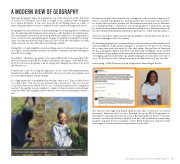
Modernizing geography also means making it as diverse as the world in which we live and elevating historically unacknowledged or excluded stories and voices. Among the young, passionate advocates for this vital chang. Among them is Francisca Rockey, a geography student at York St John University in England. As she studies for a career in biogeography and conservation, Francisca is simultaneously focused on bringing equity and diversity to geography, making it more inclusive of people of color. “People have an idea of what a scientist looks like, and it’s not me,” she said.
In the spring of 2020, Francisca posted a single tweet that changed her life:
The response was huge, and helped spark an idea that evolved into a powerful movement. Francisca and her peers launched the group Black Geographers to diversify the curriculum and raise the work of Black geographers. They’ve conducted research, started a scholarship with help from Esri, and established a mentorship program. Together, they are working to ensure Black students are empowered and encouraged to find work and have representation in the field.
    Francisca Rockey launched a movement for Black people in geography with a simple statement expressed in a tweet.
Fueling Curiosity to Foster a Healthy Planet 167


