


Page 173 - GIS for Science, Volume 3 Preview
P. 173
DRILLING INTO BRAIN SCIENCE
We discovered that most students at the end of the GSS demonstrated significant ability in using the GIS software, and some students showed strong spatial thinking and scientific reasoning skills.8 While this was reassuring, it didn’t give us any idea of what might be happening during the course and how students might be gaining these skills. Was it from the GSS, or was it just the way adolescents develop? We realized we needed to do more research.
With support from the Spatial Intelligence and Learning Center (SILC), a National Science Foundation-supported research center, we teamed with Dr. David Uttal and his colleagues at Northwestern University to dig deeper. We set up another study where we identified two student groups, one taking the GSS and another taking a similar set of classes but not the GSS. We then followed both groups through a school year and interviewed the students at regular intervals ( four times for the GSS group and twice for the non-GSS group). During interviews at the beginning and end of the year, we gave students in each group a scenario (for example “Your town needs a new landfill; how would you decide where to site it?”) and asked them to think aloud as they tried to answer the question. We videotaped the interviews and transcribed the results. We then used a dictionary of spatial language and explored which group used more spatial language. We found no statistically significant difference between the groups at the beginning of the year, but by the end of the year, the GSS students used significantly more spatial words. We also analyzed their answers to look at scientific thinking and problem solving and discovered that the GSS students used more evidence, provided more complete claims, and showed better reasoning skills than the non-GSS students.9
The research suggested many potential benefits of geospatial learning for GSS students, but the results came from a pilot study. It’s difficult to do this kind of research in schools because of all of the various factors that can impact a high school student throughout a year. Further, we could see substantial behavioral changes, but we didn’t have any evidence about changes in cognition. We decided to dig deeper.
Dr. Adam Green and his laboratory at Georgetown University joined us, and we secured National Science Foundation funding to redo our earlier study in a more rigorous fashion and add a cognitive component to assess the impact of the GSS on brain function. This study was managed by Dr. Emily Peterson, now on the faculty at American University, and focused on two school districts in Virginia near Washington, DC.
We revisited how we identified non-GSS students as a comparison group to GSS students. Using a technique called propensity score matching, we found non-GSS students who were a good match to GSS students across a number of variables (gender, age, SAT score, school grades, and so on). In this way, we tried to limit the number of confounding variables and provide a more robust comparison group. We repeated the behavioral interviews described above and added some new measures. The students also took several standard psychometric tests that evaluate spatial thinking, including the mental rotation and embedded figures tests. The students reported on the kinds of spatially related activities they participated in during their childhood and their interest in spatially related activities. Most importantly, we took a subset of students to Georgetown University and conducted Functional magnetic resonance imaging ( fMRI) scans of their brains at the start and the end of the school year. We required a parent to accompany them and surveyed the parents about their attitudes toward their child’s spatial thinking abilities.
While the analysis of these data are ongoing, we’ve already discovered a great deal.
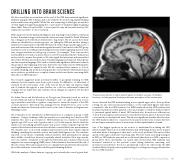
The precuneus (shown in red) is a brain region involved in a variety of complex functions, including spatial thinking and human perception of the environment.
As we observed the GSS students taking a more spatial approach to their problem solving, we also saw increased performance on the embedded figures task when compared to the non-GSS students. Our fMRI results show that GSS students had increased activation in their parietal cortex and caudate, a result we think is related to increased spatial habits of mind. GSS students also showed more efficient use of their frontal regions and increased connectivity between parts of the prefrontal cortex and motor and parietal areas. This shows a significant transfer effect because the GSS students didn’t see or practice these psychometric tests in class, but they showed improvement because of an increase in their spatial habits of mind.
One of the biggest questions in our work is to understand how taking the GSS affects transfer, that is, how do GSS students deal with things they’ve never studied and what kinds of strategies do they use to solve novel problems? We explored this question through a deductive reasoning task. We don’t teach reasoning strategies in GSS, yet GSS students reasoned more effectively than their non-GSS comparison group peers. More specifically, our neural data showed that GSS students had increased activation in the parietal cortex during deductive reasoning, and increased connectivity to the motor and parietal cortices. In other words, the GSS students likely adopted a more spatial strategy for solving reasoning problems than the non-GSS students.10
 Spatial Thinking Effects on the Human Brain 161


