


Page 174 - GIS for Science, Volume 3 Preview
P. 174
THE GEOSPATIAL SEMESTER
Our demonstration of transfer from in-classroom spatial teaching to improvements in verbal reasoning (associated with the changes in spatial habits of mind and the recruitment and connectivity of spatial brain resources mentioned earlier) is a potentially important finding in STEM education. Spatial thinking strongly predicts achievement and persistence in STEM fields.11,12 In some STEM fields, spatial ability contributes more to the prediction of achievement and attainment by scientists and engineers than SAT scores. Other research describes the evidence linking spatial ability and future STEM attainment as exceedingly strong, with more than 50 years of research and more than 400,000 participants.13 Likewise, the ability to reason is perhaps the most important cognitive skill for achievement across academic and professional pursuits, including in STEM.14,15 So, the connection of a real-world classroom approach (the GSS) with an associated neural mechanism (increased recruitment and connectivity of spatial brain resources) for improving spatial thinking and deductive reasoning has major implications.
One additional and particularly compelling finding in our study is that students in the GSS class closed the gender gap in spatial performance from the start of the school year to the end, while students in the comparison group did not. So, beyond the improvements in spatial thinking and scientific reasoning described earlier, the GSS has potential to contribute to greater inclusion in the STEM workforce, a critical national priority.
Our work helps bridge the significant gap between real-world classrooms and the laboratories that study cognitive neuroscience. The use of the fMRI has allowed us to determine that cognitive changes occurred with learning and that we can develop inferences about how these changes occur. To our knowledge, ours is the first project to measure how learning in a real-world high school class drives changes in the brain over time.
Capturing neural measures of change has provided compelling, physical evidence of the effectiveness of the GSS, which is likely to support greater implementation of a spatial approach to STEM learning and more geospatial use in the classroom. We’ll next describe the GSS course that provided these dramatic impacts to participating students.
To appreciate the learning value of the GSS, some background knowledge of its history and evolution is instructive. The GSS is a unique concurrent enrollment program in which high schools in Virginia partner with JMU to offer yearlong classes to high school seniors (and the highly motivated juniors such as Drew Mehfoud) that feature geospatial technologies and provide students the opportunity to engage in extended spatial projects that match their interests, all while earning college credit from JMU.
The program, inaugurated in 2005, has served more than 5,000 students and has introduced many students,1 such as Becky Schneider and Mehfoud, to the world of geospatial technologies. We developed the program to be a viable alternative to the test-heavy and project-light world of many high schools and to introduce geospatial technologies in a variety of contexts. Starting with four schools and a few dozen students in 2005, the GSS has grown to more than two dozen schools and more than 500 students in the current school year.
From the outset, the GSS has been a collaboration between college faculty and high school teachers to create a project-based curriculum to help students transition from high school to college, the military, or the workplace, and to a world where academic disciplines weren’t the primary organizing principle. We also wanted to give students exposure to cutting-edge technologies that might capture their
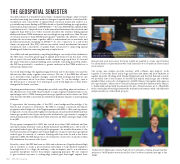
Heritage High School students from Loudoun County, Virginia, representing the GSS at the Esri Federal GIS User Conference in 2020.
interest and open new career horizons. Lastly, we wanted to create opportunities for all students, not just students who had learned how to flourish in a test-crazed environment.
Our recipe was simple—provide teachers with software and support, work together to learn the latest technology, and then visit them and their students at regular intervals. Working with Charlie Fitzpatrick and the Esri Education team, we provided school site licenses for ArcGIS and helped teachers get the software installed (later, some schools migrated to ArcGIS Online). Our regular visits gave us the opportunity to share new tools and techniques with the classes and the chance to build relationships with the students. We also offered teachers a lot of flexibility in the curriculum as we helped assess the students’ performance with oral midterms and presentations of their final projects.
Students from Washington-Liberty High School in Arlington, Virginia, presenting their projects to 16,000 people at the annual Esri User Conference several years ago in San Diego.
  162
GIS for Science


