


Page 109 - GIS for Science, Volume 3 Preview
P. 109
 INTERNATIONAL DISTINCTIONS
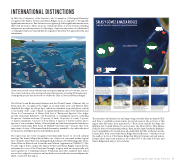
In 2014, the Conference of the Parties to the Convention of Biological Diversity3 recognized the Salas y Gómez and Nazca Ridges as an ecologically or biologically significant marine area. This distinction recognizes globally significant marine areas that need protection. These areas are evaluated based on seven criteria, including uniqueness, special importance for life stages of species, importance for threatened or endangered species, vulnerability, biological productivity, biological diversity, and naturalness
SALAS Y GÓMEZ & NAZCA RIDGES
A global diversity hotspot in need of protection
Seamounts provide critical habitats and ecological stepping-stones for whales, sea tur- tles, corals, and many other ecologically important species, including 82 threatened or endangered species that are known to inhabit the Salas y Gómez and Nazca Ridges.11
The Global Ocean Biodiversity Initiative and the Global Census of Marine Life on Seamounts also recognized the ridges as an important area, and Mission Blue identified the ridges as a Hope Spot, which are classified as special places critical to the health of the ocean.12 Based on spatial distribution data of the International Union for Conservation of Nature Red List of Threatened Species,13 the ridges provide important habitats to 82 threatened or endangered species, including 25 species of sharks and rays, 21 species of birds, 16 species of corals, 7 species of marine mammals, 7 species of bony fishes, 5 species of marine turtles, and 1 species of sea cucumber. Salas y Gómez Island and the Desventuradas Islands are considered Important Bird Areas by BirdLife International,14 because they host important colonies of Christmas Island shearwater, masked booby, white-throated storm petrel, de Filippi’s petrel, and Chatham petrel.
The region has also been recognized internationally based on its rich cultural heritage. The island of Rapa Nui includes one of the most renowned archaeological sites on Earth, which has been distinguished globally as a World Heritage Site by the United Nations Educational, Scientific and Cultural Organization (UNESCO).15 The broader region that contains the Salas y Gómez and Nazca Ridges represents the easternmost corner of the Polynesian Triangle, a region with an exceptionally rich and long history of seafaring cultures. Polynesian and other seafarers have sailed across these ridges for centuries, and archival research indicates several shipwrecks likely occurred in this region.
The Salas y Gómez and Nazca ridges are one of the most unique diversity hotspots on Earth. Located off the west coast of South America, they include over 110 seamounts that stretch across 2,900 kilometers.
© D. Wagner
The Salas y Gómez and Nazca ridges represent the easternmost corner of the Polynesian Triangle, a region with an exceptionally rich and long history of seafaring cultures.
Rapa Nui Multi-Use Marine Protected Area
Motu Motiro Hiva Marine Park
Countries’ national waters Marine protected areas 400 km
Nazca-Desventuradas Marine Park
Mar de Juan Fernandez Marine Park
© E. Sala
The region harbors one of the most unique collections of ecosystems and species on Earth. For many groups of organisms, nearly half of the species are endemic to the region and found nowhere else on our planet.
© E. Sala
Recent explorations in this region have documented one of the deepest light-dependent coral reefs on Earth, as well as numerous species that are new to science.
© R. Holler
© M. Gorny
Over 73% of these ridges lie in areas beyond national jurisdiction, where they are unprotected and under threat from overfishing, plastic pollution, climate change, and potential deep-sea mining.
© M. Imirizaldu
Due to its high productivity, the region provides important feeding grounds for a wide variety of seabirds.
Salas y Gómez Ridge
Peru
Chile
© J. Yonover
The ridges provide critical habitats and migration corridors for whales, sea turtles, and numerous other ecologically important species, including 82 threatened or endangered species.
© M. Gorny
Commercial activity is still low in this region. We must act now to protect its unique resources before they are lost forever.
The international distinctions and supporting scientific data prompted Chile and Peru to establish several marine protected areas in the portions of this region that fall under their jurisdiction.16 These areas include the Rapa Nui Multiple-Use Coastal Marine Protected Area, the Motu Motiro Hiva Marine Park, the Nazca-Desventuradas Marine Park, and the Juan Fernández Multiple- Use Coastal Marine Protected Area, all established by Chile in the last decade. In June 2021, Peru created the Nazca Ridge National Reserve,17 which protects the seafloor portion of the Nazca Ridge that falls in Peruvian national waters. Despite these important advances, more than 73% of the Salas y Gómez and Nazca Ridges lack any protected status.
Conserving the Last Ocean Frontiers 97
Nazca Ridge National Reserve


