


Page 108 - GIS for Science, Volume 3 Preview
P. 108
SEAMOUNT AND SEAFLOOR MAPPING DATA
Seamounts are defined as underwater mountains that rise at least 1,000 meters above the seafloor. Seamounts and other steep topographical features significantly impact the deeps-sea environment, because they accelerate currents, increase upwelling, and increase food supply, and thereby provide favorable habitat for a wide variety of organisms. Many conservation initiatives have prioritized seamounts for protection because they are regarded as some of the most diverse and productive habitats in the ocean.
Seamounts are widely regarded as one of the top ocean conservation priorities globally, because these features create favorable conditions and habitats for a wide variety of marine life.5
The most accurate way to identify seamounts is to map the seafloor using echosounders mounted on ships or on submersible vehicles. Using such modern mapping technologies, researchers have mapped about 20% of the seafloor to date at a resolution high enough to identify fine topographic details (~100 meters).6 Most of the areas lacking detailed mapping are located on the high seas, where there have been almost no dedicated mapping surveys, and only few surveys during opportunistic ship transits. This pattern is also true for high seas waters surrounding the Salas y Gómez and Nazca Ridges, the majority of which has not been mapped in detail using modern mapping systems.
In areas that lack high-resolution mapping, satellite altimetry data can help generate coarser maps of the seafloor that can resolve large topographical features to a resolution of about 1 kilometer. Satellite-derived bathymetry data have been used to generate various databases on seamounts and other steep topographical features. These datasets indicate that the Salas y Gómez and Nazca Ridges contain a large aggregation of seamounts and other steep topographical features, such as ridges and escarpments, which are known to provide suitable habitat for diverse marine life. The Salas y Gómez and Nazca Ridges contain an estimated 110 or more seamounts, or approximately 41% of all seamounts found in the southeastern Pacific Ocean.
High-resolution multibeam bathymetry.6
    Global seamount distribution data.7
  96
GIS for Science
Global geomorphological distribution data.9
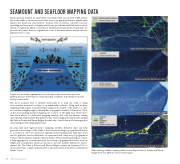
Maps showing seafloor mapping data surrounding the Salas y Gómez and Nazca Ridges from four different source technologies.
Satellite-derived bathymetry data.8


